
Best Reasons for Moving to Yorkville — Ultimate Guide 2025
29.10.2025Moving to Caledon: Complete Relocation Guide to This Charming Town
17.11.2025
How to Prepare for an Office Move: Expert Relocation Tips & Planning
Prepare for Office Move: Moving your office is more than a physical shift. It’s a chance to improve your workspace, enhance productivity, and build a better atmosphere for your team. An office move often marks growth and new opportunities, but it needs careful planning. This helps avoid disruption. Whether you’re shifting your downtown Toronto startup to a bigger spot in Liberty Village or moving your Mississauga office closer to the GO line, success relies on strategy and organization.
In this guide, we’ll show you how to prepare for your office move. We’ll cover setting timelines and budgets, minimizing downtime, and managing staff expectations. You’ll also find useful tips for Toronto and the GTA to help with logistics, vendors, and permits. With a clear plan and good preparation, your office relocation can go smoothly and set your business up for long-term success.
Why Office Moves Need Strategic Planning
Prepare for office move with a strategic approach to ensure your business transitions smoothly and efficiently. Moving an office is far more than packing furniture and electronics. It requires careful planning to minimize disruption, protect valuable equipment, and maintain productivity.
A thoughtfully executed office relocation not only keeps your operations running seamlessly but also enhances employee satisfaction, optimizes workspace layout, and supports long-term business growth. By taking proactive steps and following a detailed office move checklist, your Toronto business can achieve a stress-free move while staying fully operational and on schedule.
A well-planned office move allows you to:
- Prevent data loss and equipment damage
- Minimize operational downtime
- Stay within budget
- Improve workflow and layout in the new office
- Strengthen employee engagement and morale
- By following a clear office relocation checklist, your Toronto business can transition smoothly while staying fully operational.
Key Stages of an Office Move
Moving an office is more than just packing boxes; it is a strategic project that affects productivity, team morale, and your bottom line. A successful move begins with setting clear goals, establishing careful timelines, and maintaining communication that keeps both your team and your clients informed. In this introduction, we will explore why early planning is essential, what to prioritize, and how to minimize downtime so your business can stay on track throughout the transition.
Good office moves always start with a plan that balances both logistics and people. Begin by auditing your current assets, assigning responsibilities, and setting a realistic moving window. Create detailed checklists for IT, furniture, and records, and schedule key milestones such as site visits, vendor bookings, and data backups well in advance of the moving date. Maintaining regular communication through briefings, a shared timeline, and a single point of contact will ensure that all stakeholders remain aligned and help prevent any last-minute surprises.
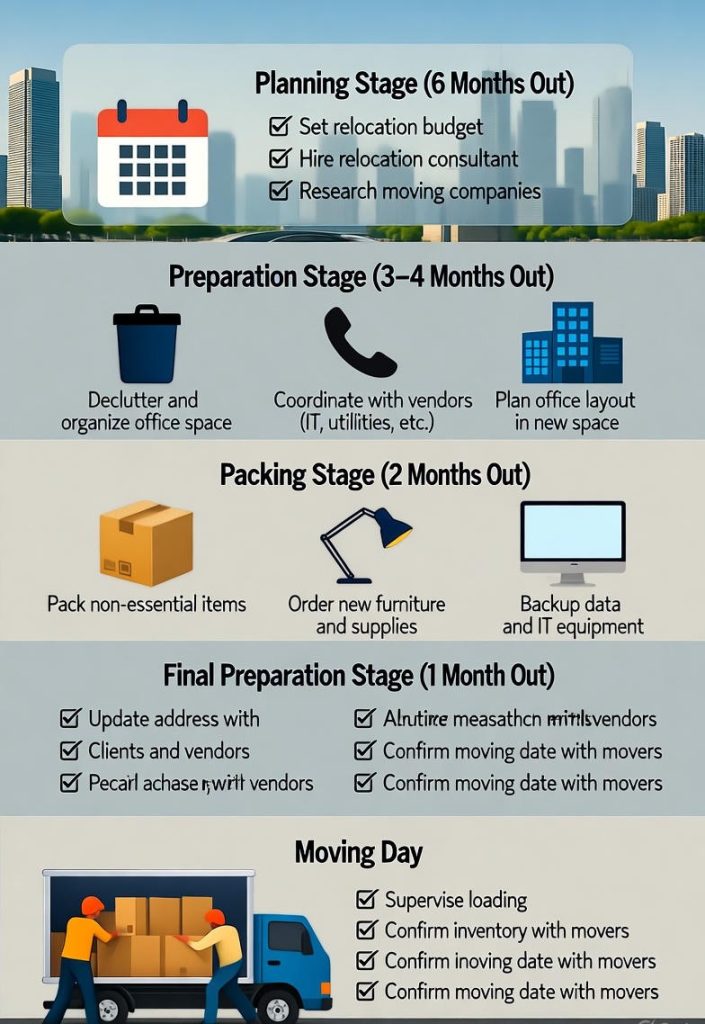
1. Planning Stage (6 Months Out)
Start your move early. Begin planning six months in advance so you have enough time to handle logistics, coordinate with vendors, and keep staff informed.
Review Your Current Lease and Give Notice
Before diving into logistics, take a close look at your current office lease. In Toronto, many commercial leases require at least 60 to 180 days’ notice before vacating, so it’s important to review your exit terms carefully to understand any potential penalties, restoration requirements, or deposit conditions.
For example, if your business is currently leasing space in North York, your landlord might require that you return the property to its original condition, which could include repainting walls or removing fixtures. Being aware of these requirements early will help you plan for any additional costs.
Secure and Assess the New Space
Once you’ve confirmed your move, it’s time to secure your new office. Work with your real estate agent to finalize the lease, and then visit the space to:
- Review the floor plans and measurements carefully to ensure they meet your needs.
- Identify any repairs or upgrades that may be required, such as improvements to lighting, wiring, or flooring.
- Confirm that the space complies with Toronto building codes and accessibility standards.
- If your new office is located in downtown Toronto, consider hiring a local commercial designer who understands urban workspace flow and can help optimize your layout for productivity.
Create a Comprehensive Moving Checklist
A moving checklist serves as your roadmap for the coming months, helping you stay organized, reduce stress, and ensure that no important task is overlooked. A well-structured checklist should include several key components:
- Budget: Account for moving company fees, new furniture, IT setup, and cleaning services.
- Vendor List: Keep track of movers, IT specialists, and signage providers.
- Timeline of Milestones: Outline important dates and deadlines to stay on schedule.
Tip: Use a project management tool like ClickUp or Trello to track progress, stay organized, and assign responsibilities.
Book Your Moving Company Early
Prepare for your office move efficiently by planning ahead and choosing the right moving partner. Takeoff Moving Company specializes in seamless office relocations, ensuring minimal downtime and a stress-free transition. To make your move smooth and organized, follow these steps:
Create a detailed inventory of office items.
- Create a detailed inventory of office items.
- Label boxes clearly for easy unpacking.
- Schedule your move in advance with Takeoff Moving Company.
- Communicate with your team about the moving plan.
2. Preparation Stage (3–4 Months Out)
Once your new location is confirmed, it’s time to prepare your team and finalize logistics. Prepare for office relocation with confidence by starting early and organizing every detail. About 3–4 months before moving day, focus on logistics, decluttering, and vendor coordination to ensure a stress-free transition.
Confirm Moving Date and Lock In Vendors
Lock in your moving date and confirm reliable vendors such as:
- IT and telecom providers for internet and phone setup
- Cleaning crews for both office locations
- Furniture suppliers and electricians for installation and setup
If you’re relocating within the GTA (e.g., Vaughan or Mississauga), coordinate with local providers to minimize downtime.
Declutter: Identify Items to Discard, Donate, or Move
An office move is the perfect excuse to declutter.
Create categories for each item:
- Keep – Essential furniture, technology, and records
- Donate – Usable items that won’t fit the new layout (e.g., chairs, monitors)
- Recycle/Dispose – Broken or outdated items
In Toronto, organizations like Habitat for Humanity ReStore and Furniture Bank accept furniture donations, which can also qualify your business for a tax deduction.
Coordinate Logistics with Building Management
Both your old and new property managers will have moving policies. Contact them to:
- Reserve loading docks and service elevators
- Clarify move-in/move-out hours
- Obtain any parking permits for moving trucks
In downtown Toronto buildings, moves often must happen after business hours to avoid disruption.
3. Packing Stage (2 Months Out)
At this point, the relocation process starts to feel real. It’s time to picture your new workspace and begin organizing the packing process.
Finalize the New Office Layout
Collaborate with your designer or move committee to confirm the final office layout. Decide on:
- Desk arrangements and seating plans
- Conference and meeting room setups
- Break areas, lounges, and collaborative workspaces
For example, if your new office is in Liberty Village, you might opt for an open-concept design that encourages creativity and teamwork — a layout that many Toronto startups favor for its energetic and modern feel.
Order Packing Supplies and New Furniture
Gather all the essentials, such as sturdy moving boxes, bubble wrap, packing tape, and labels. Many professional movers in Toronto can provide these materials.
If you’re upgrading furniture or adding new storage units, place your orders early because some deliveries may take several weeks to arrive, especially for custom pieces.
4. Final Preparation Stage (1 Month Out)
The final stretch is here! This stage is all about tying up loose ends and ensuring nothing slips through the cracks. Take the time to review all tasks, confirm responsibilities, and double-check timelines. Make sure your team is well-prepared, informed, and equipped for a smooth transition. With everyone aligned and ready, the move to your new workspace will be seamless and successful.
Confirm All Bookings
Revisit and reconfirm every booking related to your move to avoid last-minute surprises. This includes:
- Moving company and transportation schedule
- IT and phone system installation
- Cleaning services for both the old and new locations
- Building access arrangements and loading dock availability
Also, verify that your moving company provides adequate liability insurance which is a standard requirement for most commercial landlords in the GTA.
Back Up Data and Secure Sensitive Information
Protecting business data and confidential information is essential. Work closely with your IT department to:
- Complete full system backups and ensure copies are stored securely
- Encrypt sensitive files and digital records
- Safely dismantle, pack, and label tech equipment
For physical documents, use locked boxes or tamper-proof envelopes to prevent unauthorized access during the move.
Update Addresses and Coordinate Building Logistics
Notify all relevant parties of your new location well in advance. Additionally, be sure to update your:
- Website and Google Business Profile
- Business cards, letterheads, and email signatures
- Vendor, courier, and utility accounts
To ensure a seamless transition to the new office space, please verify all necessary access preparations and logistics well in advance of the move date. This proactive approach will not only minimize disruptions but also facilitate an efficient and smooth relocation for both the team and the movers.
- Confirm that all access keys, fobs, and security codes for the new office are ready to distribute to relevant personnel.
- If required, arrange for building security clearance to grant entry permissions as needed.
- Reserve elevators in advance to accommodate the moving schedule and avoid conflicts with other tenants.
- Coordinate escort access for movers if the building policy mandates supervised entry to restricted areas.
- Double-check any additional permits or protocols with building management to prevent last-minute issues during the moving process.
5. Moving Day
The big day has arrived, your office move is finally here! After weeks of planning, packing, and coordinating, Moving Day is when everything comes together. Proper execution on this day ensures a smooth transition with minimal downtime and stress. Follow this step-by-step guide to keep things organized, safe, and efficient.
Supervise Loading and Unloading
Your relocation lead should oversee both sites to:
- Direct movers and verify fragile items are handled correctly
- Ensure floors and walls are protected (Takeoff Moving Company provides padding)
- Keep pathways clear for safety
Provide movers with printed floor plans so they know exactly where to place desks, chairs, and equipment.

Final Walkthrough of the Old Office
Before the trucks roll in, do a thorough final sweep:
- Check every drawer, cabinet, and corner for forgotten items.
- Label any last-minute boxes clearly (e.g., “Fragile – IT Equipment“).
- Take photos of the empty space for your records—this can help with security deposits or disputes.
Disconnect and pack any remaining utilities, like printers or coffee machines, ensuring they’re powered down safely.
Transport and Unload Strategically
At the new office:
- Direct movers to place boxes in designated rooms based on your labeled floor plan.
- Unpack critical areas first: IT setup, reception, and break rooms to resume operations quickly.
- Inspect items as they’re unloaded—note any damage immediately on the mover’s inventory sheet.
- Do a headcount and thank your team (pizza works wonders!).
Hire Professional Movers
Hiring professional movers is one of the smartest investments you can make when planning an office move. While it may seem tempting to cut costs with a DIY approach or enlist employees, commercial relocations involve heavy furniture, sensitive electronics, and tight deadlines that demand expertise. Professional movers minimize risks, reduce downtime, and let your team focus on business—not boxes.
Here’s everything you need to know to hire the right moving company for your office relocation.
Why Hire Takeoff Moving Company?

Takeoff Moving Company
- Reliable, professional crews–Takeoff Moving emphasises its team is “highly skilled” and committed to making your move seamless and stress‑free.
- One‑stop logistics (packing, storage included) – They offer full packing services (fragile items, special wraps) and even climate‑controlled storage solutions, meaning fewer vendors to manage.
- Transparent pricing and hassle‑free booking – With Takeoff you can book online quickly, and their quote covers truck, gas, tools, insurance—no hidden fees.
- Licensed & insured for peace of mind – Their crews are fully insured, licensed and covered by WSIB (Workers’ Safety & Insurance Board) so liability risk is reduced.
- Large scale experience – More clients, more kilometres, more tons moved: they highlight thousands of clients and tens of thousands of kilometres driven & tonnes handled, which suggests capacity for a sizable office move.
Final Thoughts
Preparing for an office move doesn’t have to be a chaotic ordeal—with the right planning, checklists, and team involvement, it can transform into a seamless transition that minimizes downtime and boosts productivity. From decluttering your space and labeling boxes efficiently to coordinating with professional movers and setting up IT infrastructure ahead of time, every step plays a crucial role in ensuring your business hits the ground running in its new location.
Remember, an office relocation is more than just packing up; it’s an opportunity to refresh your workspace, streamline operations, and even reinvigorate your company culture. Start early, communicate openly with your team, and don’t hesitate to seek expert help when needed. By following these strategies, you’ll not only avoid common pitfalls like lost files or delayed setups but also position your business for long-term success in a fresh environment.
FAQs
Is it better to hire professional movers or do it ourselves?
For offices with more than 10 employees or specialized equipment, professionals are recommended to reduce risks and downtime. DIY works for very small teams but often leads to higher indirect costs from lost productivity.
How can I ensure IT equipment is safely transported during the move?
Back up all data to the cloud or external drives, label cables and devices clearly, use anti-static packaging, and hire specialists for servers or sensitive hardware. Test systems immediately after setup at the new location.
What are common mistakes to avoid during an office move?
Underestimating timeline, poor labeling of boxes, neglecting employee input, and skipping insurance coverage. Always have a contingency plan for delays like bad weather or vendor issues.
